The Myth of Sisyphus
Albert Camus (1942)
“The meaning of life is the most urgent of questions”
It was a gradual awakening. At first, like a whisper buried somewhere deep in my mind — it was more like a feeling — something that didn’t quite add up, though I was unable to name it or describe it. Slowly it became more and more conscious, and more difficult to ignore, and then finally, while reading The Myth of Sisyphus, I realized that this feeling was the Absurd (though I hadn’t known the name for it before). The problem with the Absurd is that once you discover it, there is no turning back. So consider this a warning: for those of you who are happy with the way things are, who think of themselves as holders of some sort of meaning or purpose, you may want to reconsider before reading any further.
We mostly go through life, each day passing and endlessly followed by the next, oblivious, automatically, without thinking or questioning the reasoning behind our actions. It is merely force of habit, it is cultural conditioning that led us here. We constantly jump from one distraction to another, and remain ignorant of what lies behind our actions and decisions. We attempt to occupy every empty and dull moment of our existence — especially with phones, but I won’t get into that right now. But all it takes is to stop for a moment, even accidentally, to realize that one day, all of this will be over, and none of it will have mattered, that there is no Rational Order to be a part of, no Grand Scheme by means of which you will get what you deserve, that the universe is not just, and that you and your actions simply don’t matter. This is the Absurd.

So the question is, when — if — you take a step back and look at every single decision you’ve ever made, all the actions which have brought you to this day, and inevitably arrive at the conclusion that it was all pointless, then what? Once you feel that inescapable sense of futility, that ineluctable feeling that everything that you’ve lived for has been nothing but a lie (although, whose lie?), every goal you’ve set for yourself and everything you’ve done has been nothing more than a ridiculous waste of time, what is there left to do? In other words, if it’s all meaningless, why bother doing anything at all? Or as Camus puts it:
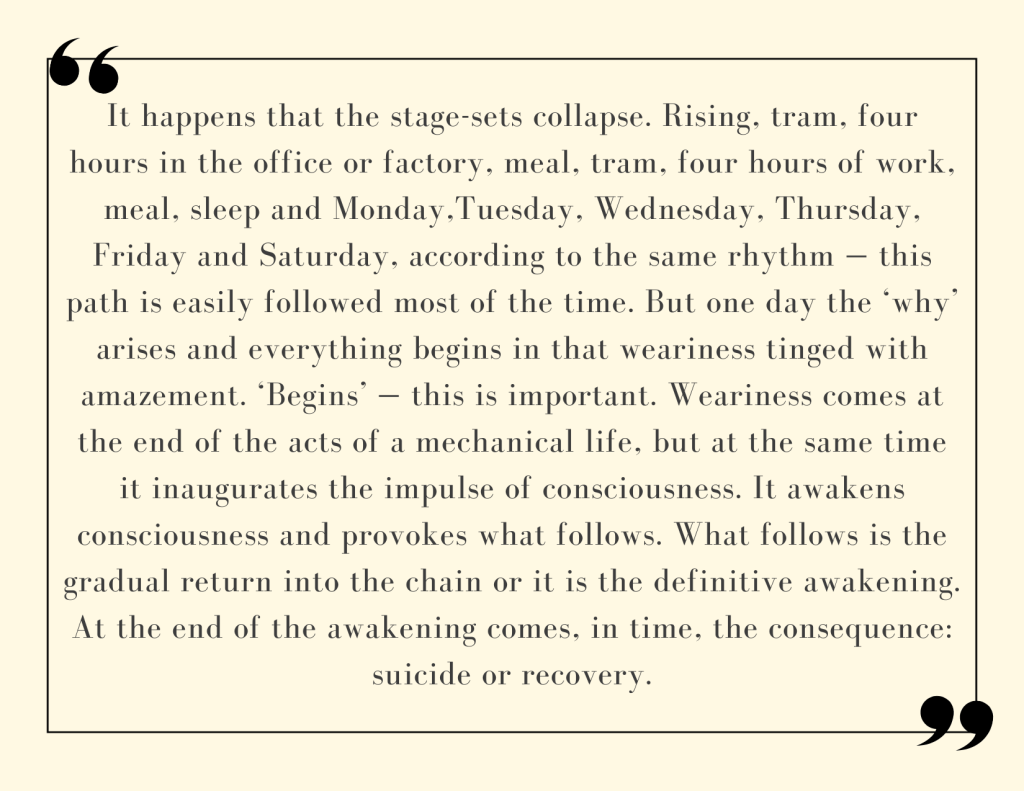
Camus sets out to discover whether one can live with the awareness of the Absurd, whether or not life requires meaning in order to be lived. It’s probably easy to imagine that upon discovering the futility of an action — any action — and the profound indifference of the universe to it, anyone’s first inclination would be to hand in their resignation to life, wait for it to be over (maybe even take matters into their own hands). In fact, how can you explain any actions, how can you motivate yourself to do anything, if, in the end (and worse, even from the start), it doesn’t matter? It seems all human actions are directed by a purpose (or the illusion of one); therefore, a complete lack of purpose should bring human activities to an abrupt halt. I mean, if there’s nothing worth living for, no compensations in the afterlife for all our struggles (and no punishment for our sins), if there’s no bigger picture to be a part of, how does one justify their actions? Camus explains that, even if there were an inherent meaning to the universe, the answer will always remain beyond our grasp. What use could we have for things that are outside of our grasp? So whether there is meaning or not, the matter remains unchanged. But one must go on living.

The way we normally go through life postulates our inherent freedom; we assume our actions have meaning because we have hope for the future. But this freedom is an illusion: we are bound to our expectancy of meaning, to the constant anticipation of the future (or for a better afterlife). The Absurd laughs in our face and mocks us for our stupidity, for our naivety. There is no future, there is no afterlife, no order, nothing that is rightfully yours by “divine right”. But do not despair! For this is exactly where our freedom lies: the universe is indifferent, and thus we owe it nothing: there is no right or wrong, there is nothing you should or should not do. Consciousness of the Absurd is the basis of freedom.
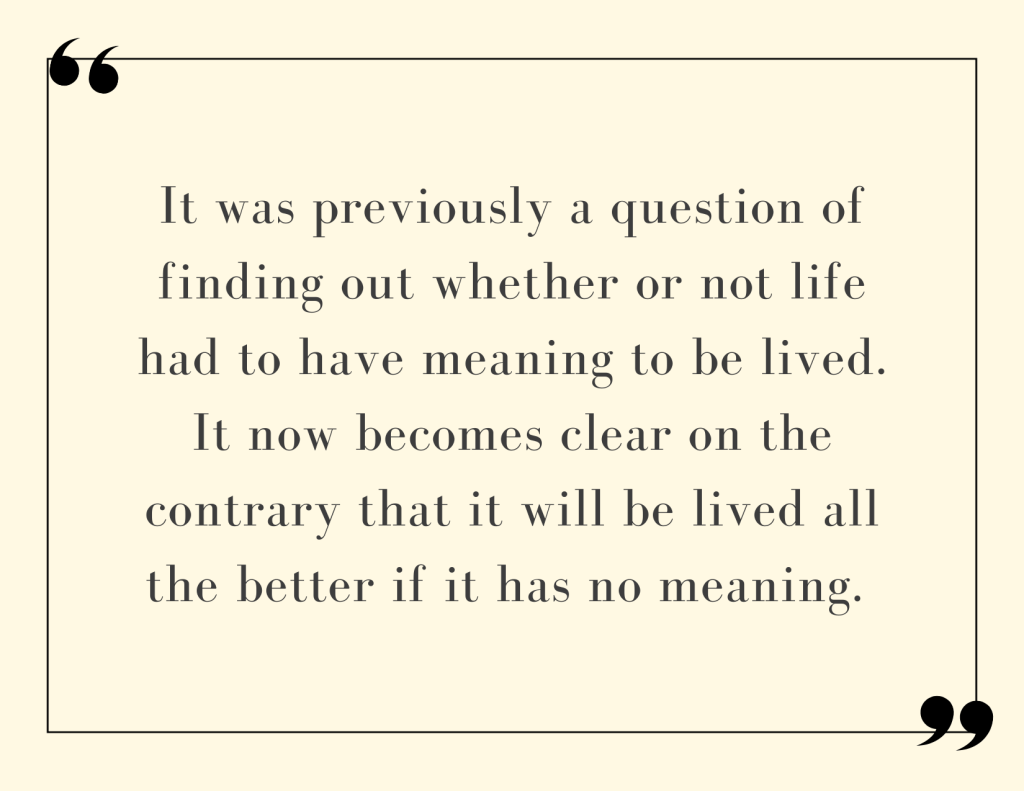
Camus’ realization is not only that it is possible to live in spite of life’s meaninglessness, but that meaninglessness is actually what makes life worth living. If god exists (if a rational order, and if meaning, exists), everything depends on him, and we can (and, who knows, maybe we should) do nothing against his will. If he does not exist, everything depends on us. Thus, the realization that the universe, and our existence, is meaningless, leaves us utterly free to choose what to do, and who to be (“There is no frontier between what a man wants to be and what he is”).
Camus gives Sisyphus the role of the Absurd hero: the famous myth tells the story of a man who, punished by the gods, spends his infinite existence pushing a rock up a mountain, only to watch it roll back down, and start again. Sisyphus is one who knows all his struggles are futile, and that “his whole being is exerted towards accomplishing nothing” (he has to push the rock up the mountain over and over, we will die and become nothing), but his awareness of this is what sets him free.
Picture Sisyphus, alone and sweaty at the foot of the mountain. His rock has rolled back down and is lying next to him. He takes a deep breath, and readies himself to push it back up again. He stands behind the rock. He throws all his weight and force against it, when finally he feels it tilting slightly. He slowly continues pushing it as he moves forward, knowing he cannot stop until he reaches the top, or else the rock will roll back down. Imagine that, as he struggles and pushes with for all he’s worth, he thinks to himself that this will be the last time he does so. That this time, the rock will stay put at the top of the mountain, that he will have accomplished his goal, and then, he will be free. Imagine him full of hope and desire to be relieved of this burden. He continues the climb, his arms and legs sore, his hands bleeding. He knows he’s getting closer to the top now, he can almost feel his freedom. Finally, he reaches the top, and gives his rock one last push. It seems stable against the ground.
He has done it, he has fulfilled his purpose. He looks over proudly to his rock, when he sees it slowly tipping back in the direction from which they’ve arrived. “No”, he says, and he attempts to hold the rock still, he pulls it, he hugs it, shouting “No!”, but the rock is too big, and too heavy, and Sisyphus can do nothing but watch it roll down, knowing he’s going to have to go back for it. In short, if Sisyphus believes that his struggles will be rewarded, he will find nothing but disappointment. If Sisyphus realizes what his fate is, and comes to face the fact that he will inevitably have to continue rolling his rock, forever up the mountain, then he will be free: “his fate belongs to him. His rock is his thing”.

This knowledge, if you choose to believe it, puts life back into your hands. It is not up to god or to any rational order, it is only up to you. We are the makers of ourselves. If you accept this life, if you agree to live in this universe which is neither fair nor unfair, then you must bear the consequences of your choice. It’s not easy to look at ourselves and admit that nothing is forcing us to exist each day, that there is no reason to do anything unless you choose it. You are always free to leave. And though I’m aware of how awful and difficult life can be, you have to admit that life isn’t unfair: nowhere is it written that things should go in a certain way, that anyone deserves anything, allowing you to point out that something is against the ‘rules’. It’s your fault for having believed in such a thing as fairness.
[All quotes from: A. Camus, The Myth of Sisyphus, Penguin Books, London (2005)]
Support the blog

Leave a comment